

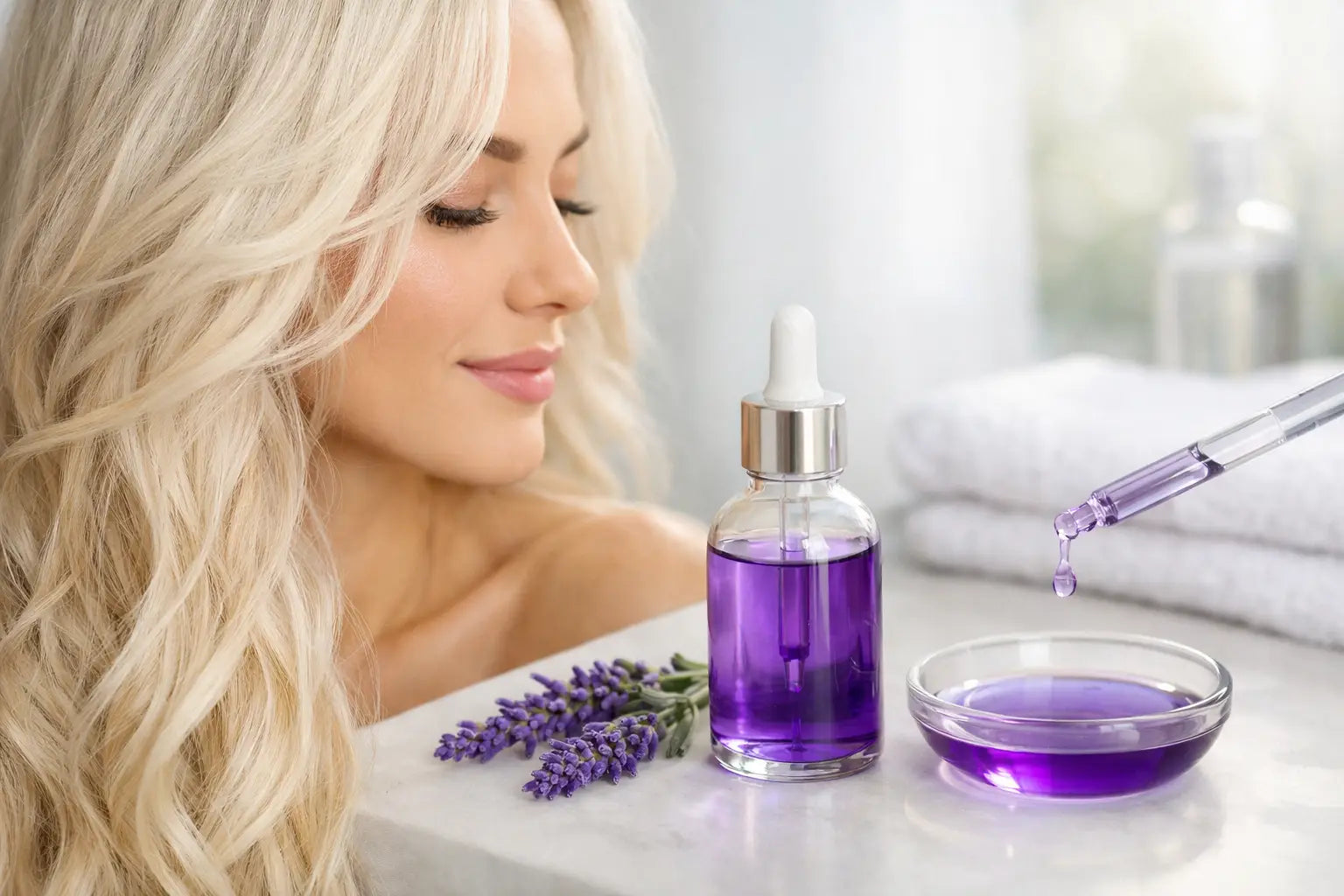
Fresh blonde can look expensive for about five minutes before real life gets involved. Heat, hard water, sun, styling, old colour, porosity - it all shows up fast. That is exactly why violet toning oil for blonde hair has become such a smart modern staple. It gives you tone support and softness in the same step, which matters if your hair needs correction but also feels dry, frizzy or overworked.
Traditional purple products have their place, but they can be blunt instruments. If your blonde is already porous, frequent toning shampoos can leave it feeling rough, tangled or a little flat. An oil-led format shifts the experience. You are not just trying to cancel warmth. You are restoring balance, shine and a smoother finish while keeping your blonde looking cleaner and more refined.
What violet toning oil for blonde hair actually does
At its simplest, violet toning works on colour theory. Purple sits opposite yellow on the colour wheel, so violet pigment helps neutralise brassy, golden or slightly yellow tones that creep into blonde, silver and lightened hair over time. In an oil format, those pigments are paired with emollients that coat the hair fibre, helping it reflect light more evenly.
That second part matters more than many people realise. Brassiness is not always just a colour problem. Dry, rough hair catches light badly, which can make blonde look dull, uneven and warmer than it really is. When hair is smoother and better conditioned, the tone often appears cleaner. So a violet toning oil is doing two jobs at once - soft colour correction and cosmetic repair.
The result tends to be subtler than a strong purple shampoo. Think cooler, brighter, more polished hair rather than an abrupt tonal shift. For many people, that is exactly the appeal. It is easier to control and better suited to regular use.
Why oil can work better than shampoo for some blondes
If your hair is fine, heavily highlighted, bleached, silver, or colour-treated, you already know the trade-off. Products that help tone can sometimes leave the lengths feeling thirsty. Products that nourish can sometimes be too rich or leave tone untouched. Violet toning oil sits in the middle.
Because it is designed to smooth and soften while depositing violet pigment, it can be a gentler option for hair that does not respond well to repeated cleansing-based toning. That does not mean it replaces every purple shampoo or salon toner. It means it fills an important gap in the routine - especially between salon visits, or when your blonde looks a little too warm but your ends are begging for moisture.
There is also a styling benefit. Oils help tame frizz, reduce the look of split ends and add that light-catching finish blondes often lose first. If your hair looks better the moment it feels silkier, the format makes immediate sense.
Who it suits best
Violet toning oil is especially useful for cool blondes, bleached hair, balayage with pale ends, platinum shades, silver tones and highlighted hair that picks up warmth easily. It also suits colour-treated hair that needs maintenance without another stripping step.
That said, results depend on your starting point. If your hair is very orange or deeply brassy, an oil alone is unlikely to do all the heavy lifting. Stronger correction may still need a salon gloss or a more intensive toning product. On the other hand, if your blonde is only slightly warm, or your silver has started to look a touch yellow, an oil can be the elegant fix.
It is also worth paying attention to porosity. More porous hair tends to grab pigment quickly, which can make any toning product behave more intensely. Less porous hair may need more regular use before you notice a visible shift. There is no single rule here. It depends on your colour history and the condition of your lengths.
What to expect from the finish
The appeal of a violet toning oil is not only what it removes, but what it adds. Used well, it helps hair look calmer, glossier and more expensive. Blonde can lose that reflective quality very quickly when the cuticle is raised or moisture is low. Oil helps restore the look of alignment, which is why the finish often appears brighter even before tone correction is obvious.
You should expect softness, shine and more controlled texture alongside a cooler appearance. You should not expect a dramatic salon-level transformation from one use, particularly if your hair is dark blonde or has strong yellow-orange staining. Think maintenance, refinement and balance rather than rescue.
For many people, that is a better long-term relationship with tone. Less panic. More consistency.
How to use violet toning oil for blonde hair
Application is where the difference between polished and patchy usually sits. Start small. One to three pumps is often enough, depending on your hair length and density. Warm the oil between your palms, then work it through mid-lengths and ends first, where dryness and visible brassiness tend to show most clearly.
If your hair is very fine, keep application light and focused on the outer layers and ends. If it is thicker, drier or more textured, you can distribute a little more generously. Comb through if you want a more even finish. On damp hair, the effect is usually softer and more diffused. On dry hair, it can feel more concentrated and immediately glossing.
Timing and frequency depend on your hair. Some people like to use it after every wash in small amounts. Others prefer it as a between-wash refresh when tone starts to slip. If your blonde is highly porous, start with less and build slowly. You want your colour to look bright and balanced, not over-toned.
Where it belongs in a modern blonde routine
The best routines are not crowded. They are consistent. A violet toning oil works well as part of a simplified ritual - cleanse, condition, protect, tone where needed, and support the hair fibre with products that keep it feeling strong and hydrated.
This is why the format fits so naturally into a more mindful approach to beauty. You are not chasing correction with a shelf full of harsh fixes. You are choosing a product that helps hair look and feel better in the same moment. That dual benefit is particularly attractive if you want your routine to feel elevated rather than clinical.
For blondes who like a polished but low-effort finish, a product such as PRYZME VIOLA makes sense in that space. It speaks to the idea that effective haircare should be high-performing, sensorial and easy to live with.
Common mistakes that can affect the result
The first is using too much. More oil does not always mean better tone. It can simply weigh the hair down, especially if your texture is fine. The second is expecting violet pigment to fix every type of warmth. Yellow and pale brassiness respond best. Orange usually needs something stronger.
Another common issue is uneven application. If you only smooth oil over the top layer, the surface may look cooler while the underneath still reads warm. Work methodically, especially around the front where blonde tends to be most visible.
Finally, do not ignore the bigger picture. If your water is hard, your heat styling is aggressive, or your lengths are breaking, tone will only ever be part of the answer. Healthy-looking blonde is always a blend of colour maintenance and condition.
Is it better than purple shampoo?
Better is not the right question. Better for what is.
Purple shampoo is useful when you want stronger cleansing-based toning and you do not mind a product that can feel a little firmer on the hair. Violet toning oil is often better when your priority is softness, shine and gentle maintenance with less risk of that dry, overprocessed feel. Many blondes use both, just not with the same frequency.
If your hair is delicate, over-bleached or naturally dry, an oil may become the product you reach for more often. If your brassiness builds quickly and heavily, shampoo may still have a role. The smartest routine usually sits somewhere between correction and care.
Blonde always looks best when it is balanced. Not too warm, not too flat, not so over-toned that it loses dimension. A good violet toning oil supports that middle ground beautifully - cooler where you need it, softer everywhere else, and easy enough to become part of the ritual you actually keep.

